All About Circuits Forum  

Go Back   All About Circuits Forum > Electronics Forums > The Projects Forum

Notices

The Projects Forum Working on an electronics project and would like some suggestions, help or critiques? If you would like to comment or assist others with their projects, this is the place to do it.

Reply   Post New Thread
 
Thread Tools Display Modes
  #1  
Old 11-12-2009, 12:34 PM
cazksboy's Avatar
cazksboy cazksboy is offline
Junior Member
 
Join Date: Nov 2009
Location: Overland Park, Kansas
Posts: 21
Default New to this board, advice sought for project idea

Hello all, I just found this message board last week and this is my first post. I've been fascinated with electronics since high school but I've never had any formal education. I would say my soldering skills are good but not great (I need practice!).

My hobby is repairing antique clocks and I have an idea for a project I want to build but I haven't the foggiest notion how to go about it. My hope is that someone in this community can at least guide me toward the right circuit to build my project. I want to build a diagnostic tool for "setting the beat" of an antique spring-driven or weight-driven clock. "In beat" is when the silences between the "tick" and the "tock" sound are perfectly even, and "out of beat" is when they are uneven. Such a sound is easy for someone with a strong sense of rhythm to hear, but not everyone has such a sense and it's nice to have an instrument to quantify the setting.

I want to build a handheld box containing a small audio amplifier fed by a wire with a tiny microphone or pickup at the end. The mic would be placed next to the escapement mechanism (the source of the tick-tock sound), and the mic's signal would in turn trigger a series of LED's. I'm envisioning a single row of 7 or so LED's, with the center one green for "perfectly in beat" and the ones on the left or right would pulse another color when the beat is close, but not perfect.

I have other design details I'd like to include, but those could be enumerated later. The above is my basic idea. It needs to be inexpensive, above all other considerations. I'm not seeking to patent anything or make a million bucks off this idea because it's already been done by at least two manufacturers - I just want to make a "poor man's version" of this product: http://www.bmumford.com/mset/specs.html . One detail I'd like to build into my box would be a miniature noise gate between the mic and the signal processor so that the mic would be impervious to ambient noise.

Can anyone point me to what kind of circuit would take a signal from a mic and make it drive a series of LED's in the manner described above? Hopefully I've been clear, but maybe I haven't been.

Thank you in advance,
Doug H.
Reply With Quote
  #2  
Old 11-12-2009, 12:37 PM
Bill_Marsden's Avatar
Bill_Marsden Bill_Marsden is offline
E-book Developer
 
Join Date: Mar 2008
Location: Dallas, TX (GMT-5 w/ DST)
Posts: 8,653
Blog Entries: 5
Default

Welcome aboard.

Sounds easy, but I don't have a clue at the moment. You want something to show percentages, or milliseconds? I'm betting percentages myself.
__________________
..
"Good enough is enemy of the best." An old engineering saying, Author unknown.

General info:
If you have a question, please start a thread/topic. I do not provide gratis assistance via PM nor E-mail, as that would violate the intent of this Board, which is sharing knowledge ... and deprives you of other knowledgeable input. Thanks for the verbage Wookie.
Reply With Quote
  #3  
Old 11-12-2009, 12:54 PM
cazksboy's Avatar
cazksboy cazksboy is offline
Junior Member
 
Join Date: Nov 2009
Location: Overland Park, Kansas
Posts: 21
Default

Hi Bill,
Thanks for the speedy reply! Didn't think I'd get feedback so quickly. Hmm, percentages or milliseconds......not sure, really. Here's what I'm thinking...imagine a series of seven LED's in a straight row. Left to right, let's call them #1, #2, #3, etc. on up to #7. Number 4 is the one I want to glow green only when the silences between the "tick" and "tock" sounds are exactly the same. Alright, LED #1 (on the extreme left) should blink rapidly when it's "out of beat" by a defined amount, but as I adjust the clock's beat and get closer to "in beat" (but not perfect yet) then LED #1 stops blinking and LED #2 starts blinking, but a little slower than #1. Similarly, as the clock continues to be adjusted, eventually only the center LED would light up but NOT BLINK. The LED's on the right would blink like #'s 1, 2, & 3 but according to which silence is longer: "tick......tock" or "tock.....tick". I hope I'm making myself clear! I'm not really sure.

Anyway, the gradual visual indication via LED's being triggered by milliseconds or percentages - I'm not sure! Seems like a circuit that could measure every OTHER sound as the "measuring ruler" could be used as the standard by which determining whether the sound in the middle is centered or not.
Reply With Quote
  #4  
Old 11-13-2009, 12:01 PM
cazksboy's Avatar
cazksboy cazksboy is offline
Junior Member
 
Join Date: Nov 2009
Location: Overland Park, Kansas
Posts: 21
Default

Ideas, anyone? What kind of circuit would convert a series of pulses from a microphone into a blinking LED depending on how steady the pulses are?
Reply With Quote
  #5  
Old 11-13-2009, 12:27 PM
Bill_Marsden's Avatar
Bill_Marsden Bill_Marsden is offline
E-book Developer
 
Join Date: Mar 2008
Location: Dallas, TX (GMT-5 w/ DST)
Posts: 8,653
Blog Entries: 5
Default

The first thought I have is to somehow start a monostable on a tic and a toc. I'm thinking there would be a silent area, just befor the next sound. The problem is how to convert the duration of each of the 2 pulses into the format you want.
__________________
..
"Good enough is enemy of the best." An old engineering saying, Author unknown.

General info:
If you have a question, please start a thread/topic. I do not provide gratis assistance via PM nor E-mail, as that would violate the intent of this Board, which is sharing knowledge ... and deprives you of other knowledgeable input. Thanks for the verbage Wookie.
Reply With Quote
  #6  
Old 11-13-2009, 01:07 PM
Duane P Wetick Duane P Wetick is offline
Senior Member
 
Join Date: Apr 2009
Location: Erie, PA UTC+5 or GMT-5
Posts: 281
Default

It seems like the first problem is to discriminate between the tick and tock of the mechanism. Maybe just a simple counter (flipflop), whose first state starts a shift register (SR) counting pulses. The next (tock) stops the register. The number of pulses counted corresponds to the number of LED's lit. Now you need to hold this data, while a second shift register starts on the (tock) and stops on the next (tick). The second registers data LED's corresponds to the interval between (tock) and (tick).
Now you hold this data just long enough to compare to the first SR. Then the cycle repeats as you adjust your mechanism. When both LED banks are equal, your clock is tuned.

Cheers, DPW
Reply With Quote
  #7  
Old 11-13-2009, 01:49 PM
cazksboy's Avatar
cazksboy cazksboy is offline
Junior Member
 
Join Date: Nov 2009
Location: Overland Park, Kansas
Posts: 21
Default

Thanks guys. Those responses make sense to me - now, how do I translate that into a working prototype? I've found a few prototyping designers in the yellow pages but they've quoted me prices approaching nearly a thousand bucks - I'm not savvy enough to actually design & build a circuit like that. Am I stuck with having to pay big dollars for a unit that works?
Reply With Quote
  #8  
Old 11-13-2009, 03:57 PM
someonesdad someonesdad is offline
Senior Member
 
Join Date: Jul 2009
Location: Northwest USA
Posts: 705
Default

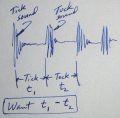
If I understand your problem statement right, you want to measure t1 - t2 as shown in the attached figure, right?

If I had to solve this problem, I'd put the microphone next to the clock and connect the microphone's output to an oscilloscope, perhaps through an amplifier. The scope could be used to visually adjust things until t1 - t2 was near zero. This measurement has a discrimination on the order of 1%, more if you use a digital scope that can perform timing measurements.

If this wasn't a good enough measurement, then one could use digital counters to count the time between the ticks and the tocks; effort would be needed to get the triggering right on the different sounds -- this is why a scope approach would be valuable, as you could see how the signals from different clocks differ before you design/build any hardware.

You can get a suitable new scope in the range of $250-$500 (here's one). Since you're probably measuring periods on the order of a second, you'll want a digital storage scope, not an analog scope. Of course, the scope is useful for many other things too (next to a digital multimeter, it's one of the most useful electrical measurement tools to have).

I'd make a trace for you to see what this would look like on a scope, but I don't believe we have any of these old-style clocks around our house.
Attached Images
File Type: jpg tick_tock.jpg (38.6 KB, 13 views)
Reply With Quote
  #9  
Old 11-15-2009, 12:19 PM
cazksboy's Avatar
cazksboy cazksboy is offline
Junior Member
 
Join Date: Nov 2009
Location: Overland Park, Kansas
Posts: 21
Default

Someonesdad, you nailed it. Your illustration captures what I'd like to be able to measure. The two periods of silence beteween the tick sound and the tock sound need to be equal, so T1 should equal T2, per your illustration. I don't want to resort to an oscilloscope, though, because isn't there a simpler way? I see examples of "rate counters" all the time (sorry, I don't know the right terms), such as on an exercise machine that has a readout of your "steps per minute", or the hospital machine that reads heart rate. For that matter, I have a home heartrate device that reads heart rate that presumably is not as sophisticated as the hospital version. So.....there is such a thing a circuit that takes repetitive events and calculates their rate and outputs a corresponding display.

I guess I'm trying to nail down the following: what simple, inexpensive circuit would emulate that portion of an oscilloscope's function which would compare T1 and T2, and display the discrepancies as a blinking colored LED, and the similitude of T1 and T2 as a steady "other color" LED?

That part comes first for me...I haven't even broached the topics of the refinements I want to include!

Thanks guys for bearing with me...I think we're getting somewhere...
Reply With Quote
  #10  
Old 11-15-2009, 02:03 PM
Bill_Marsden's Avatar
Bill_Marsden Bill_Marsden is offline
E-book Developer
 
Join Date: Mar 2008
Location: Dallas, TX (GMT-5 w/ DST)
Posts: 8,653
Blog Entries: 5
Default

To me, that seems easy. Where I'm having a bit of trouble coming up with something is the discriminator for the two times. I have the sense it should be easy, but I keep thinking you may need to do something with a µC (which I never think of as easy) to compare the two numbers and display them. An analog approach would work fine, as I understand it.
__________________
..
"Good enough is enemy of the best." An old engineering saying, Author unknown.

General info:
If you have a question, please start a thread/topic. I do not provide gratis assistance via PM nor E-mail, as that would violate the intent of this Board, which is sharing knowledge ... and deprives you of other knowledgeable input. Thanks for the verbage Wookie.
Reply With Quote
Reply   Post New Thread

Bookmarks

Tags
, , , ,

Thread Tools
Display Modes

Posting Rules
You may not post new threads
You may not post replies
You may not post attachments
You may not edit your posts

BB code is On
Smilies are On
[IMG] code is On
HTML code is Off

Forum Jump

Similar Threads
Thread Thread Starter Forum Replies Last Post
Project Idea Suggestions Sought sivakumar.b Homework Help 1 12-22-2008 01:14 PM
Advice on Microcontroller Learning Sought aliashar86 Embedded Systems and Microcontrollers 9 06-27-2008 04:34 AM
SBC with jumpers and a double sided board mik3ca General Electronics Chat 9 02-27-2008 01:09 PM


All times are GMT. The time now is 10:15 PM.


User-posted content, unless source quoted, is licensed under a Creative Commons Public Domain License. Powered by vBulletin® Version 3.8.5
Copyright ©2000 - 2010, Jelsoft Enterprises Ltd.