Facebook
 Google
 GitHub
 Linkedin
I'm designing and building a pathfinding robot as a 'children's toy' for my design materials class.
It will only ever turn in one direction and is controlled by only one sensor. When the sensor is low both motors are in their forward state, when the sensor goes high one of the motors switches to its reverse state. This will result in one of two things, either my robot will spin in circles because my logic does not work fast enough, or it will swiftly spin until it is facing a direction in which there is no object within range. Hopefully it is the later of the two.
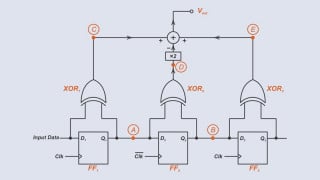
I intend to build this without the use of an ic. I will use one if I have to, but I think that I can do without. I will have one motor hard wired to a forward position. The other motor will be dependent on a switch (hopefully not a logic gate, but I will use one if I have to) to control the other motor's direction. The file I have attached is the logic I will use if I cannot use some other switching device (please suggest). The shining light bulb shown in the schematic is the motor in its forward state, the light bulb that is off represents the motor in its reverse state.
I also need help choosing an appropriate sensor technology for the robot. Following are two links to a IR LED and a IR phototransistor. They are both at a 940nm wavelength and very cost effective. I chose a phototransistor with a wider viewing angle than the diode in hopes to collect more of the emitted light without detecting objects that are clearly not in my way.
Digi-Key part number: 67-1001-ND (ir emitter) - http://search.digikey.com/scripts/DkSearch/dksus.dll?Detail&name=67-1001-ND
Digi-Key part number: 160-1065-ND (phototransistor) - http://search.digikey.com/scripts/DkSearch/dksus.dll?Detail&name=160-1065-ND
Following are some more links to other products I will be using to build my project, please alert me if any red flags go up while going over these, I have checked over them thouroughly to ensure that they are all compatible, please double check.
Small solid soft-rubber wheels (good for gripping floors) - http://www.robotshop.ca/banebots-04in-05hex-wheels.html
1/2" hexagonal hub with 4mm bore - http://www.robotshop.ca/hex-hub-s40-4mm-1wide.html
Motor geared at 30:1 with 427 RPM with no load (providing 6.62 Kg/cm of torque) with 4mm shaft - http://www.robotshop.ca/banebots-30-1-25mm-spur-motor-ff180.html
I also have a rechargeable Li-ion battery from an old digital camera.The battery housing from the camera seems to be removable. I plan to mount the housing to the robot to have an easily removable/rechargeable battery (the battery itself removes to charge in an external charger). The battery is extremely light weight and runs at 3.7V with 740mAh. Should this be enough to run my logic circuit and both motors? The battery has three terminals (- / + / T), I was hoping you could tell me what the T terminal is for.
Thank you so much for all your help, I've been completely lost without any of my old notes from my high school electronics class.
It will only ever turn in one direction and is controlled by only one sensor. When the sensor is low both motors are in their forward state, when the sensor goes high one of the motors switches to its reverse state. This will result in one of two things, either my robot will spin in circles because my logic does not work fast enough, or it will swiftly spin until it is facing a direction in which there is no object within range. Hopefully it is the later of the two.
I intend to build this without the use of an ic. I will use one if I have to, but I think that I can do without. I will have one motor hard wired to a forward position. The other motor will be dependent on a switch (hopefully not a logic gate, but I will use one if I have to) to control the other motor's direction. The file I have attached is the logic I will use if I cannot use some other switching device (please suggest). The shining light bulb shown in the schematic is the motor in its forward state, the light bulb that is off represents the motor in its reverse state.
I also need help choosing an appropriate sensor technology for the robot. Following are two links to a IR LED and a IR phototransistor. They are both at a 940nm wavelength and very cost effective. I chose a phototransistor with a wider viewing angle than the diode in hopes to collect more of the emitted light without detecting objects that are clearly not in my way.
Digi-Key part number: 67-1001-ND (ir emitter) - http://search.digikey.com/scripts/DkSearch/dksus.dll?Detail&name=67-1001-ND
Digi-Key part number: 160-1065-ND (phototransistor) - http://search.digikey.com/scripts/DkSearch/dksus.dll?Detail&name=160-1065-ND
Following are some more links to other products I will be using to build my project, please alert me if any red flags go up while going over these, I have checked over them thouroughly to ensure that they are all compatible, please double check.
Small solid soft-rubber wheels (good for gripping floors) - http://www.robotshop.ca/banebots-04in-05hex-wheels.html
1/2" hexagonal hub with 4mm bore - http://www.robotshop.ca/hex-hub-s40-4mm-1wide.html
Motor geared at 30:1 with 427 RPM with no load (providing 6.62 Kg/cm of torque) with 4mm shaft - http://www.robotshop.ca/banebots-30-1-25mm-spur-motor-ff180.html
I also have a rechargeable Li-ion battery from an old digital camera.The battery housing from the camera seems to be removable. I plan to mount the housing to the robot to have an easily removable/rechargeable battery (the battery itself removes to charge in an external charger). The battery is extremely light weight and runs at 3.7V with 740mAh. Should this be enough to run my logic circuit and both motors? The battery has three terminals (- / + / T), I was hoping you could tell me what the T terminal is for.
Thank you so much for all your help, I've been completely lost without any of my old notes from my high school electronics class.
Attachments
-
 2.2 KB Views: 51